Hot Water Cylinder Diagnosis: Safe Checks, Then the Fault
Cylinder troubleshooting and diagnosis is a fixed price of £180. There is no call-out fee, and no VAT is charged. Start with the safe checks you can make yourself: the programmer, the thermostat dial and the fuse or breaker. A competent diagnosis then tests the cylinder in a fixed order, from supply to shell, until one part is proved faulty.
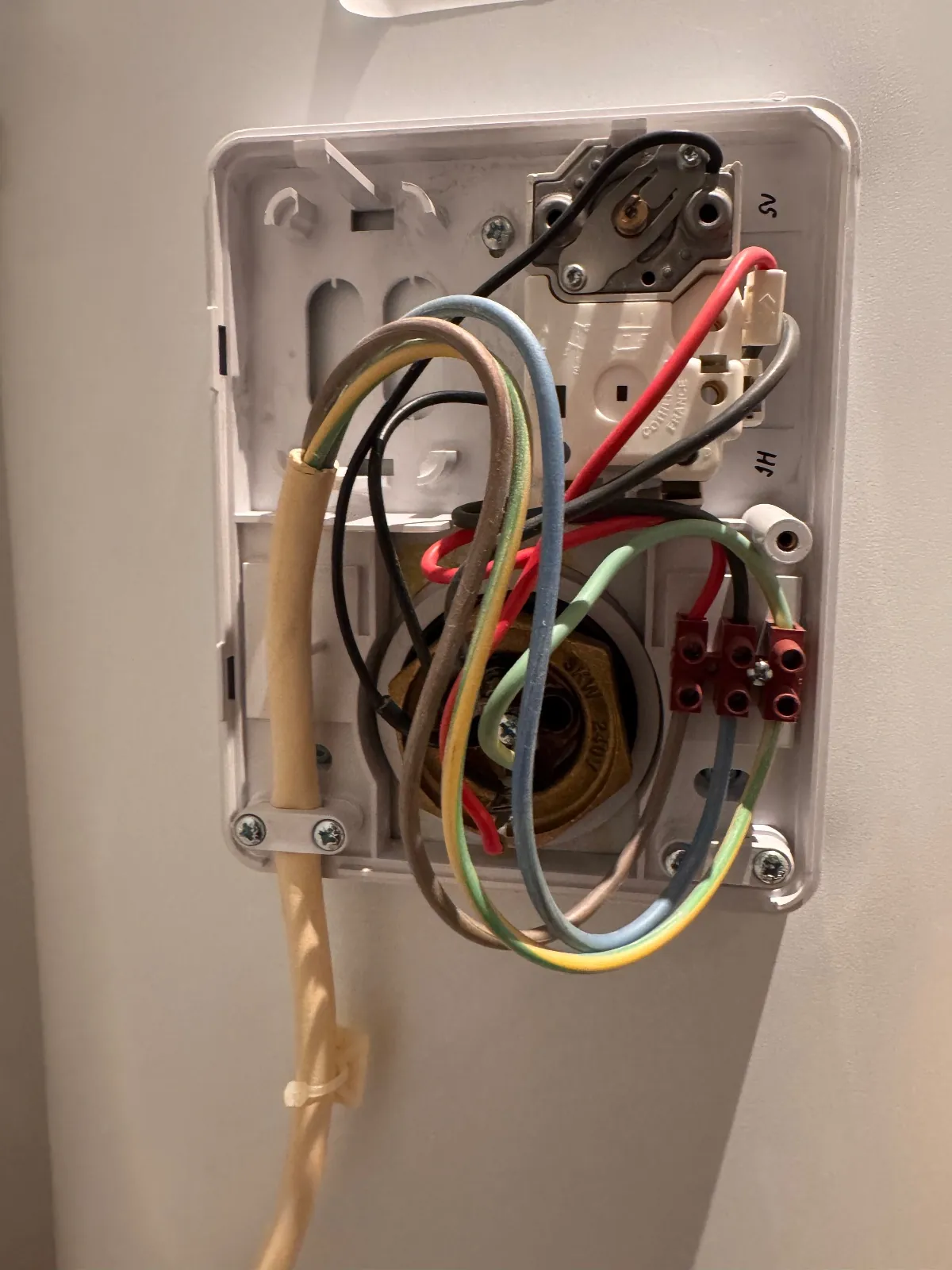
What the visit covers
- Safe first checks for a cylinder that gives no hot water
- What to note down and report about the symptom
- An ordered test from supply and fuse through to the cylinder shell
- How the test differs for vented, unvented, indirect and immersion-only cylinders
- How one named fault turns into a repair or replace decision
Fixed prices
What it costs
- Cylinder troubleshooting and diagnosis
- No call-out fee.
- £180Fixed price
No VAT is charged
There is no call-out fee
Order of work
Describe the symptom exactly
No hot water, lukewarm water, a leak, a dripping valve or a noise each point at a different branch of the test order. When it started and what changed first both matter.
Make the safe checks
Programmer, thermostat dial and fuse or breaker. Nothing is opened, and a tripped breaker is reset once at most, and not at all where there is water near the cylinder or its wiring.
Test the chain in order
Supply and fuse, then programmer and thermostat, then the heat source, then the zone valve and valve group, then the shell, each result noted as pass or fail before moving on.
Decide on the finding
A sound shell with a failed bolt-on part is a repair. A leaking shell or a failed sealed coil points to replacement.
No hot water: what can you safely check first?
Start where the fault is cheapest to find. Look at the programmer and confirm the hot water channel is on at the time you are testing.
Then check the cylinder thermostat dial, if yours is accessible, is not turned right down. Finally look at the fuse or breaker feeding an immersion heater, usually a fused spur or switch near the cylinder with a neon light. A dead neon usually means something upstream has lost power, though the neon itself can fail.
Reset a tripped breaker once, not repeatedly, and not at all if there is water around the cylinder or its wiring, a burning smell or a scorched switch. A breaker that trips again straight away is reporting a fault, such as an element leaking current to earth, and holding it in is unsafe. Stop at these three checks. Anything that needs a cover removed carries mains voltage.
Scalding water, or steam or very hot water coming from an unvented cylinder? Turn off the heat source at the isolator, keep clear and call an engineer. Can you smell gas? Leave the property and call the National Gas Emergency Service on 0800 111 999.
What does a hot water cylinder diagnosis cost?
Cylinder troubleshooting and diagnosis is a fixed price of £180. It covers the ordered test set out on this page, from supply and fuse through to the cylinder shell. There is no call-out fee, and no VAT is charged.
If the finding is a failed cylinder, the cylinder itself is priced separately, by type, size and your preference, and we recommend the right one for your home. The diagnosis is available across London inside the M25, 24/7.
What order is a hot water cylinder tested in?
A cylinder stores heat and releases it safely, so faults fall into a short chain: power or fuel reaches the heat source, the controls ask for heat, the heat source delivers it, the water is held without escaping, and the shell stays watertight.
A failure early in the chain makes later parts look dead. A melted fuse upstream of an immersion heater looks exactly like a burnt-out element.
- Supply and protection: the fused spur or isolator, the fuse, the consumer unit and any RCD trip.
- Programmer or timer: whether it is calling for heat when you think it is.
- Cylinder thermostat and high-limit cut-out: set point, wiring and whether the manual-reset cut-out has tripped.
- Heat source: immersion element continuity and insulation to earth, or coil flow and return on an indirect cylinder.
- Zone valve: whether the motorised two-port valve opens and proves its end switch.
- Valve group and discharge route: strainer, pressure reducing valve, expansion relief valve, temperature and pressure relief valve, expansion vessel and tundish.
- Shell and connections: seams, bosses, coil joints, the base and the insulation.
How does the test change for vented, unvented and indirect cylinders?
A vented cylinder is open to the atmosphere through a vent pipe and a loft tank, so pressure faults are rare and leaks are usually at joints or the shell. An unvented cylinder is fed from the mains and held under pressure, which is why it carries a valve group and expansion vessel. Those parts add a whole branch to the order, covered in TPRV and expansion vessel repair.
An indirect cylinder is heated by a coil from a boiler or heat pump, so the zone valve and coil flow are tested. Radiators working while the taps stay cold points at the zone valve, the cylinder thermostat or the hot water channel on the programmer rather than the boiler. A direct cylinder relies on its immersion elements alone, and many cylinders have both. If the immersion heater works and the coil does not, the problem is on the heating side. If neither works, a cause shared by both, such as a tripped cut-out on a combined control, is likelier.
What does a test result look like, and what does an element reading show?
Each test should end as a result, not a feeling: voltage present or absent, element reading against its expected value, thermostat opening and closing, zone valve end switch proved, discharge at the tundish continuous or intermittent. That is what separates a diagnosis from a visit that ends in a guess.
The element reading is the clearest example. A 3 kW element on a 230 volt supply should read roughly 17.6 ohms across its terminals, from 230 squared divided by 3,000. An open circuit across the terminals, or a low reading from either terminal to earth, names the element as the fault. A normal reading with no heat points back up the chain to a thermostat, cut-out or supply fault. Test with the supply isolated and proved dead, using the right meter.
How does a diagnosis become repair or replace?
If the failed part is bolt-on and the shell and coil are sound, you repair. Elements, thermostats, cut-outs, zone valves, valve groups, tundishes and expansion vessels are all replaceable without touching the cylinder. Cylinder fault repair covers each part, and immersion heater replacement covers the element branch.
If the shell is weeping at a seam, the base is corroded or a sealed coil has failed, the cylinder cannot be repaired in place and replacement is the honest answer. Leaks should be traced before that call, as set out in cylinder leak repair, because a weeping valve joint often looks like a failed shell.
Replacement is then planned like-for-like where it fits, and the route is laid out in the cylinder replacement hub. The fixed prices are on the pricing page.
Questions people ask
How much does a hot water cylinder diagnosis cost?
Cylinder troubleshooting and diagnosis is a fixed price of £180, and no VAT is charged. There is no call-out fee. If the cylinder itself has failed, it is priced separately by type, size and your preference, and we recommend the right one.
How do I test a hot water cylinder?
Work in order: supply and fuse, programmer, thermostat, heat source, zone valve, valve group, then the shell. Only the programmer, the thermostat dial and the fuse or breaker are safe for a householder to look at. Everything inside covers, valves and enclosures needs the right meters and training.
Why is there no hot water but the heating works?
The boiler is probably fine. The usual causes are the hot water channel on the programmer, the cylinder thermostat, the motorised zone valve on the coil circuit or a tripped cut-out. An immersion heater, if you have one, helps separate heating-side faults from cylinder faults.
Is it safe to keep resetting the breaker?
No. Reset it once at most, and not at all if there is water near the cylinder or wiring. If it trips again, there is a fault, often an element leaking current to earth. Leave the heater off and have it tested.
Do I need a new cylinder if I have no hot water?
Not usually. No hot water is more often a fuse, timer, thermostat, element or zone valve fault than a failed cylinder. A leaking shell or a failed sealed coil is what moves the answer to replacement.
What if no fault is found on the day?
Intermittent faults happen, such as a thermostat that sticks only sometimes. The sensible next step is a targeted retest of the suspect part, not replacing parts to see what changes.